Applications:
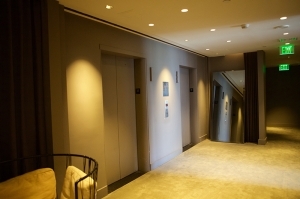
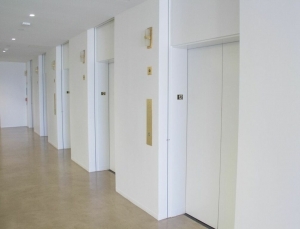
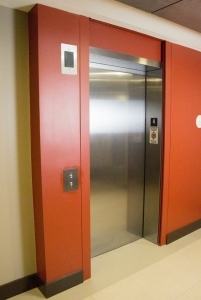
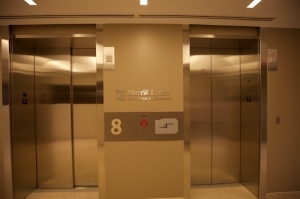
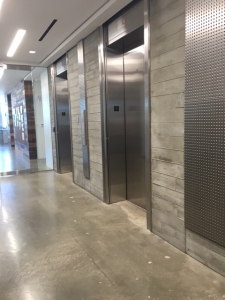
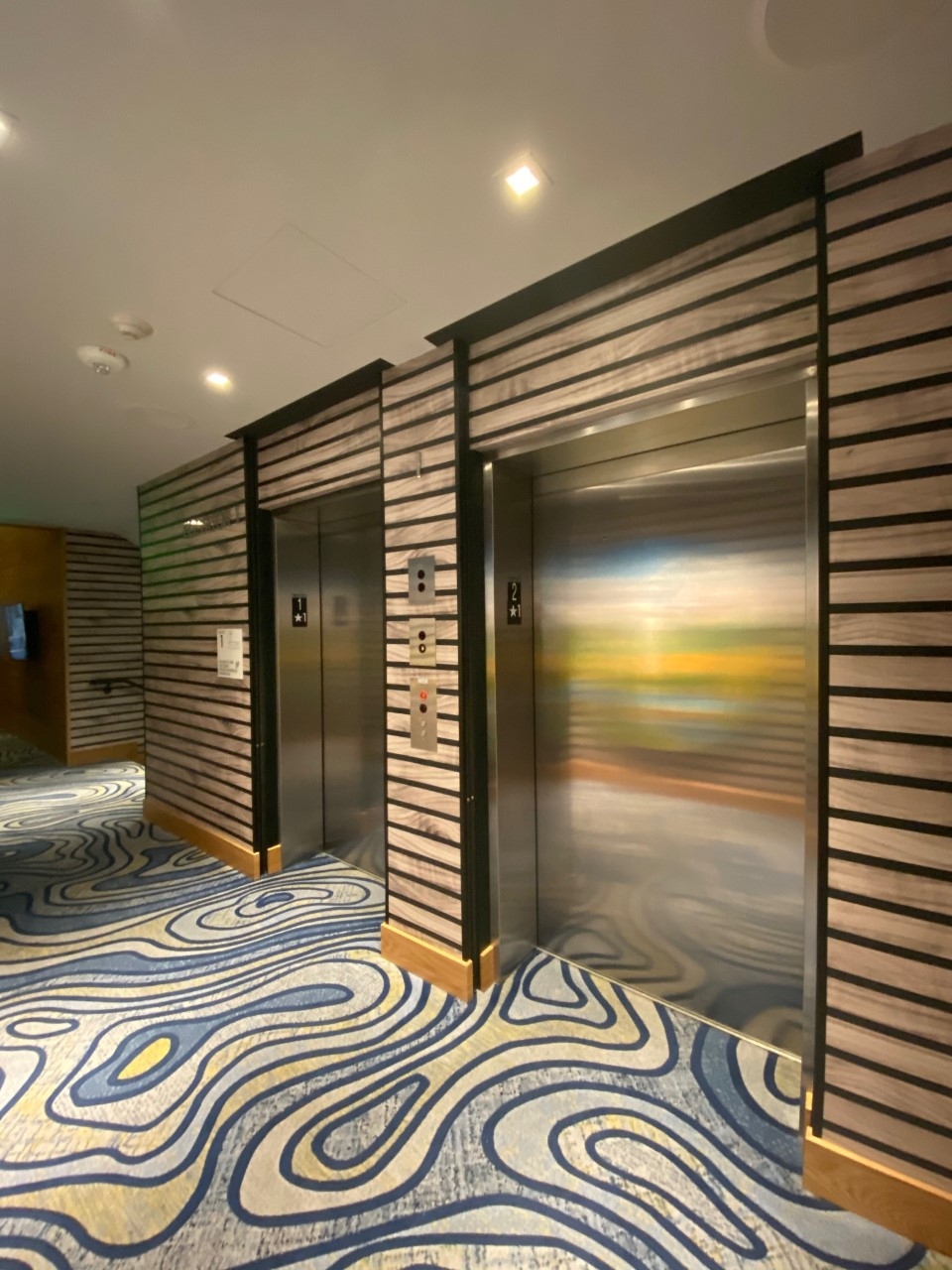
- Elevator Hoist way Smoke Containment
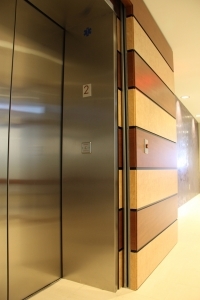
- Elevator Lobby Smoke Containment
Description:
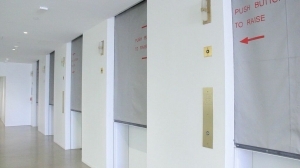
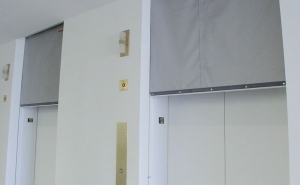
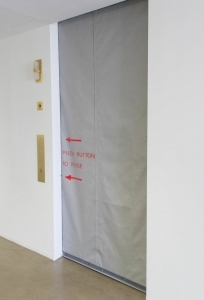
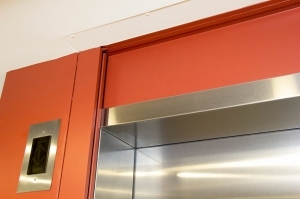
Both SD60GS® curtain systems consist of a coated filament glass curtain, sheet metal headbox, side guides, bottom bar, roller assembly, and an electronically operated drive-control system. The filament glass fabric curtain is attached to the roller assembly within the headbox. The edges of the curtain incorporate steel retaining tabs, which secure the curtain within the side guides. The headbox is positioned above the elevator or elevator lobby opening and the side guides are installed from the floor to the underside of the headbox on both sides of the protected opening. The bottom edge of the curtain is terminated with a weighted bottom bar, which enables the curtain to descend under gravity. Deployment of the curtain is automatic upon receipt of an alarm condition, and the curtain is retracted upon clearing of the alarm condition. The SD60GS® curtain systems must be connected to the building fire protection system or to a smoke detection system located adjacent to the curtain. Rewind switches located on either side of the barrier retract a deployed smoke containment system upon command via Section 3002.6 of the IBC. Rewind switches are permitted to be mounted on the wall adjacent to the side guides, mounted on the side guides directly, or incorporated into the curtain panel as membrane switches. If an alarm condition is still detected after egress, the curtain systems will redeploy.
SD60GS® Fire-protective Smoke Curtain: The SD60GS® Fire-protective Smoke Curtain is intended for installation at the intersection of the elevator lobby and corridor as an alternative to the enclosed elevator lobby required by Section 3006.3 of the IBC. When installed as indicated in this report, the system forms a protective opening in a smoke partition and is an alternative to the smoke and draft control doors required by Section 710.5.2.2 of the IBC. The system may be configured with multiple roller assemblies, provided the curtain panels are overlapped 24-inches. In the case of a loss of power, a horizontal force of less than 15-pounds applied to the curtain overlap is required to open a pass-through slot that can be used to exit the deployed curtain.
Testing & Certification Agency Listings:
ICC ACC 77 Code Compliance Research Report 0568-Intertek
ICC AC 77 ICC ESR 3322- International Code Council
ASTM E84- Intertek
UL 1784 -Intertek
UL 1784 UL
Lobby Curtain
UL 10C- 20 minutes- Intertek (Elevator Lobby)
Technical Information:
- Robust Construction- Headbox manufactured 18-gauge steel, all glass textile with polyurethane coating- The complete assembly is listed which is the headbox, fabric, motor and bottom bar.
- Accessible Maintenance- Removable bottom cover plate of headbox at ceiling for access to the low voltage motor and fabric.
- Single Roller Head Box Sizes- 7-inch by 7-inch headbox for single roller system up to 10-foot drop height (refer to headbox sizing chart)
- UL 864 listed Battery Back Up- Standard 2 12-volt batteries in UL 864 listed Control Panel and Motor Controller typically 40-feet away from Curtain head box for 14-2 low voltage wiring, 12-2 low voltage wiring for 80-feet away from Curtain headbox.
- Control Panel-- connected directly to Addressable Fire Alarm system by closed contact that opens on fire signal from Smoke/ IR detector. The contact type must be volt free, dry contact. Each Control Panel draws 7 amps. Control Panel requires 120 volt, typically a 20-amp circuit breaker. The circuit shall be a dedicated circuit marked life safety. Each control panel can control 4 motors. Each curtain roller utilizes 1 motor.
- Smoke Detector Activation- the Smoke/IR detector wiring can be wired directly to the Control panel if there is no central fire alarm system in the building.
FREQUENTLY ASKED QUESTIONS (FAQ):
Does the fabric come in various colors?
The fabric comes in gray only.
Does the headbox come in different colors?
Yes, Ral colors, white, gray, black standard and all other Ral Colors optional. USSF recommends factory-etched primed and paint in field so that the sheen will match better.
Can the side guides be fully recessed in walls and what is the minimum size?
Side guides are a manufactured steel extrusion 2-inches in width and 4-inches in depth. The side guide can be recessed into the wall cavity typically 2 to 3-inches.
What is the drop speed of the smoke curtain?
NFPA 80 Chapter 21 Fire Protective Curtains states that drop speed must be 6-inches to 24-inches per second.
Does the curtain automatically reset when the smoke/IR detector or fire alarm system reset to normal non-alert mode?
Yes, the system is automatic. Once the closed contact from FAS opens, the curtain drops to its operational position and when the FAS contact closes, the curtain motors engage, and the curtain retracts back inside its headbox.
What are the egress options for the side guided system?
Screen rewind switches on both sides of the curtain.
Does the manual grab strap constitute egress?
No, the manual grab strap does not allow the fabric to recoil more than 24-inches. If push to exit egress is required, the USSF magnetic seal type curtain should be specified.
What states do not allow a Side Guided elevator curtain?
Pennsylvania and Tennessee.
Do all elevator curtains come with a view panel?
Yes, all elevator curtains come with a view window to meet the 2013 elevator code.
I need a 2-hour elevator curtain because it is a 2-hour shaft, am I correct?
No, because the elevator door has a 2-hour listing already and the elevator shaft is a 2-hour firewall. All you need to do is provide a smoke containment system so that if smoke comes into the hoist way from the first floor or any other floor, the curtains deploy to contain the smoke within the hoist way and not spread to the corridors above or below.
My steel elevator door is old. Does it still need a fire curtain?
The age of steel does not matter; the age of steel does not compromise the fire rating.
Are auxiliary rails side guides?
No, auxiliary rails are 2-inch-wide metal strips utilized for magnetic seal elevator smoke curtains. The auxiliary rails are installed above the elevator frame to the bottom of the ceiling. Thus, if the ceiling height is 9-feet and the top of the elevator frame is 7-feet, then the metal strip called an auxiliary rail is 2-feet in height. The term auxiliary rail is confusing, but this is an addition to the elevator frame so the magnet can adhere from the bottom of the headbox to the top of the elevator frame and then adhere to the magnetized elevator frame. If the elevator frame is not magnetized, then the metal strip must be installed the entire length from ceiling to floor for the magnetic type elevator curtain.
What are the options to meet the IBC code requirements for elevator smoke containment for my project?
Option 1-Pressurization of the hoist way. That answer alone should make it clear that there is no fire rating requirement at all for elevator smoke containment since an air pressurization system installed to force air upwards along the Y-axis to a roof vent to expel the smoke would meet the IBC requirement. Option 2-Smoke doors on hold open. This works by containing the smoke at the elevator door if the door was in front of the elevator, but more likely at the elevator lobby interface. This smoke door would contain the smoke to the elevator lobby and protect smoke from spreading to the fire exits in the corridors.
I have a 10-floor hoist way with basement level and 2-floor garage with no vestibules, do I need elevator smoke curtains on all the floors?
If the building is fully sprinklered to NFPA 13, the answer is on the level of discharge where the elevator recalls to, there is no requirement for a smoke curtain. If the building is not fully sprinklered to NFPA 13, then the level of discharge will require an elevator smoke curtain. USSF recommends a magnetic seal curtain for level of discharge.
VIEW IMAGES OF THE SMOKE CURTAIN IN ACTION: